


 English
 Español
Author: Admin
Date: May 08, 2026
Why Do Custom Gift Boxes Arrive with Loose Edges
Delivering premium packaging should feel consistent and reliable, yet issues like loose edges still appear during production and shipping. Many brands using custom gift boxes notice this defect, especially in complex designs, where structure, adhesive control, and material tension all interact. Strong gift box packaging ideas often focus on appearance first, but structural precision matters just as much as visual design. Even well-designed packaging can fail if edge bonding or board alignment is not properly controlled during manufacturing.
We have observed this issue frequently in production and quality feedback, especially for retail and promotional packaging projects.
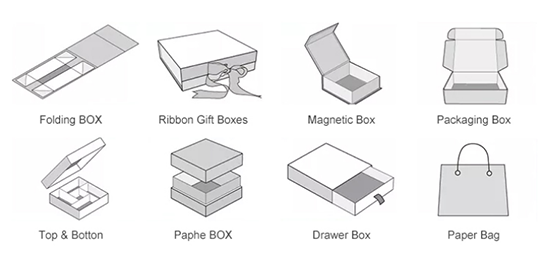
1. Weak adhesion at wrapped edges
Loose edges often come from insufficient glue bonding between the paper wrap and the grey board.
- Glue viscosity too low during lamination
- Uneven glue distribution on corner folds
- Premature drying before full compression
- Poor pressure application during forming
Industry observations show edge separation is a common finishing defect in rigid box production, especially in wrapped structures where multiple layers must bond tightly.
2. Inaccurate die-cutting and board alignment
Precision cutting plays a direct role in edge tightness.
- Die-cut deviation causes misaligned folds
- Board offset leads to uneven edge wrapping
- Small tolerance errors multiply at four corners
Even a 1–2 mm mismatch can create visible gaps or “floating” edges after assembly. This becomes more noticeable in larger format custom gift boxes where structural tension is higher.
3. Material stiffness mismatch
Different paperboards react differently under folding pressure.
- Too rigid a grey board resists clean folding
- Too soft a board collapses under pressure
- Mixed stiffness between layers creates a tension imbalance
When internal rigidity and outer wrapping material are not matched properly, corners tend to lift slightly after forming and drying.
4. Moisture and environmental distortion
Humidity during production or storage affects edge stability.
- Paper absorbs moisture and expands
- The drying stage causes uneven contraction
- High humidity weakens adhesive strength
This results in subtle warping that pulls edges away from the core structure, especially in large batch production environments.
5. Excessive manual handling during assembly
Handwork variability is another hidden factor.
- Uneven folding pressure between operators
- Inconsistent corner pressing time
- Misalignment during the final wrapping stage
Even small inconsistencies can accumulate across production lines, making loose edges more frequent in high-volume orders.
6. Structural design limitations
Some gift box packaging ideas prioritize aesthetics without enough structural engineering.
- Oversized lid-to-base ratio creates tension
- Sharp corner designs increase folding stress
- Lack of reinforcement at edge points
Without reinforcement layers or proper crease design, edges naturally loosen after repeated handling or transport vibration.
7. Adhesive aging and curing issues
Glue performance does not stop at application.
- Insufficient curing time before stacking
- Low-quality adhesive loses elasticity
- Temperature fluctuations during drying
As the adhesive stabilizes unevenly, edges may slowly lift after packaging is completed.
8. Transport vibration and compression stress
Even well-made packaging can loosen during logistics.
- Carton stacking pressure compresses corners
- Vibration during transport weakens edge bonds
- Repeated handling creates micro-separations
Shipping conditions amplify any small structural weakness already present in production.
Engineering parameters we control
To reduce loose-edge defects, we standardize several technical controls:
- Grey board thickness: 1.5–3.0 mm depending on load
- Adhesive solid content: 45–60% industrial-grade PVA
- Corner pressing pressure: controlled 0.2–0.5 MPa
- Curing time: 6–12 hours before stacking
- Moisture range: maintained 45–55% RH during assembly
These parameters help stabilize edge bonding and reduce deformation during both production and transport.
Practical quality improvement approach
Manufacturers focusing on custom packaging reliability often apply:
- Pre-production dieline verification
- Edge reinforcement tape or internal folding locks
- Controlled humidity workshop environments
- Random batch stress testing before shipment
Such steps significantly reduce loose-edge occurrence in mass production.
Share:

CONTACT
Get in touch
Recommended Products

KEEP IN TOUCH
-
 +86-18158771568
-
 scott_fifun@163.com
-
 +86-577-68681111
-
 Building 1, No. 1600-1662, Longjin Avenue, Longgang City, Wenzhou City, Zhejiang Province, China
CONTACT US
We will respond meticulously to any questions and feedback from customers.
Copyright © Zhejiang Feifan Printing Co., Ltd. All Rights Reserved.

OEM Modern Packaging And Printing Manufacturer

